


TikTok loves skincare that sounds futuristic, and Medicube Exosome Shot lands right in that sweet spot. It is sold as a kind of “liquid microneedling” serum: prickly, active, texture-focused, and buzzy enough to make people believe something dramatic is happening the second it touches their face.
I get the appeal. A product that promises smoother texture, brighter skin, and a more refined look around pores—without the downtime of actual microneedling—is always going to attract attention.
But this is also the kind of product category where the marketing can outrun the reality. Once terms like “exosomes,” “regeneration,” and “collagen support” enter the conversation, it becomes very easy to confuse a short-term smoothing effect with meaningful long-term structural change.
Those are not the same thing.
So this Medicube Exosome Shot review is the grounded version: what it is, how it feels, what the 2000 and 7500 versions mean, whether it actually helps with texture and pores, and how much credit the exosomes really deserve. I’ll also compare it with VT Reedle Shot, because if you are shopping this category, that is one of the most useful comparisons you can make.
The short version: I can absolutely see why people like it for texture. I am much less convinced that the most noticeable results come from the exosome story.
What Is Medicube Exosome Shot?
Medicube Exosome Shot is a K-beauty treatment serum aimed at rough texture, dullness, and visible pores. The formula combines hydrolyzed sponge spicules, mild exfoliating acids, and supportive ingredients like niacinamide and panthenol. Medicube also highlights Lactobacillus extracellular vesicles, which is where the exosome marketing comes in.
The key thing to understand: this is not professional microneedling, and it should not be treated like an at-home substitute for an in-office procedure.
What it is, more realistically, is a high-sensation texture serum. It is designed to feel active, deliver a prickly application experience, and leave skin looking a little smoother and fresher with careful use.
Why it gets called “liquid microneedling”
That label comes from the spicules.
Spicules are tiny, needle-like structures derived from sponge material. In skincare, they create the prickly, stingy sensation people keep describing in products like Medicube Exosome Shot and VT Reedle Shot. They are a big part of why these formulas feel more intense than a standard serum.
That does not make them equivalent to professional microneedling. The comparison is more about the sensation and texture-focused concept than true procedure-level remodeling.
What the 2000 and 7500 versions mean
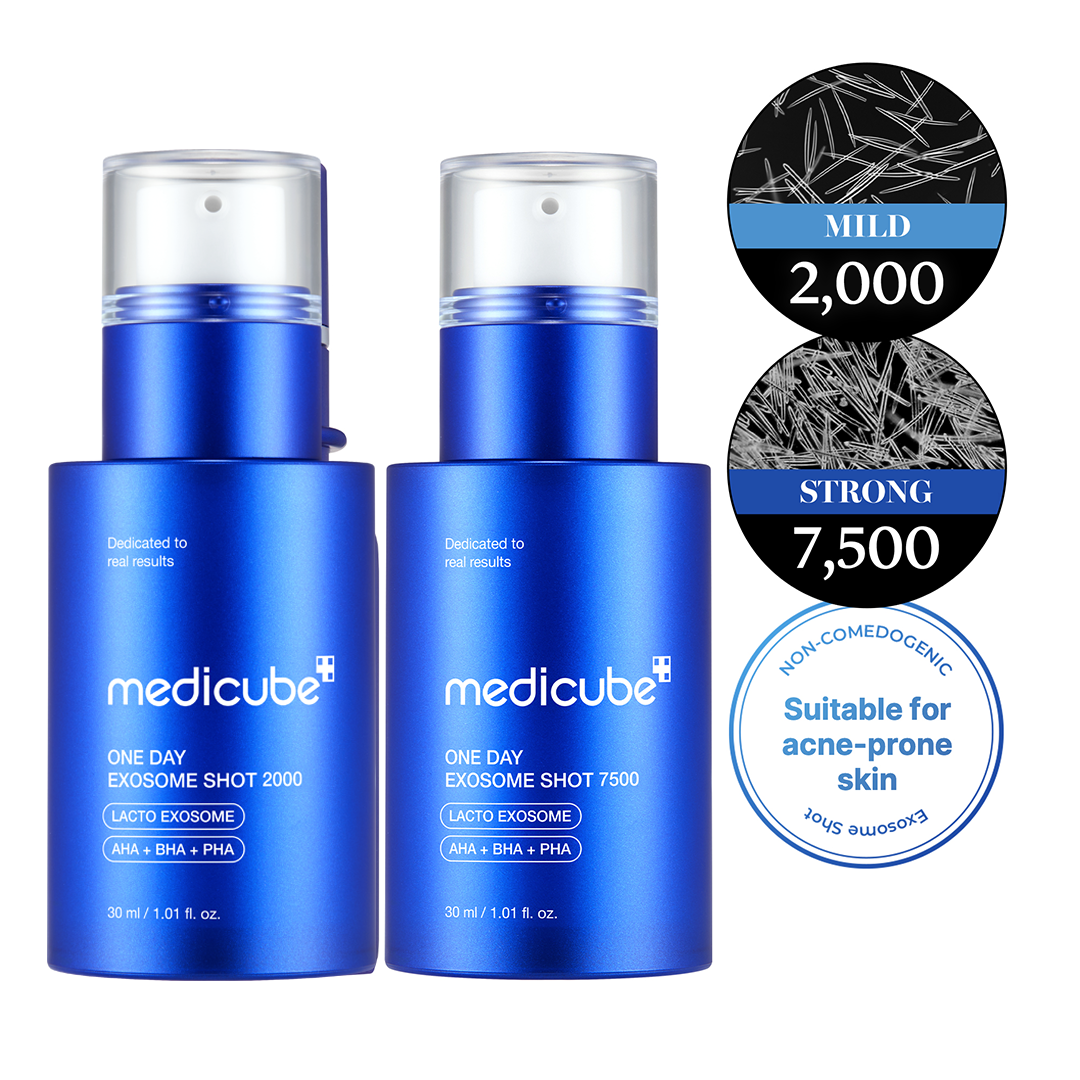
Medicube sells different strength levels, with 2000 positioned as the milder entry point and 7500 as the stronger version.
- more noticeable prickling
- more irritation potential
- less margin for error if your skin is already stressed
If you are new to spicule products, the higher number is not a badge of honor. It is just a stronger experience.
Who this product is really for
Medicube Exosome Shot is clearly aimed at people who want:
- smoother skin texture
- a more polished look around pores
- a quick glow boost
- a product that feels active enough to seem worth the hype
If your skin is resilient and you enjoy trying stronger K-beauty treatments, that may sound exciting.
If your barrier is already fragile, or your skin reacts badly to acids, retinoids, or friction, this is probably not your smartest first step.
What’s Actually in Medicube Exosome Shot?
The reason this product took off is simple: it combines several trend-friendly skincare ideas in one bottle. Exosomes. Spicules. Mild resurfacing. Pore care. “Glass skin” language. Strip the hype away, though, and the formula makes straightforward sense.
Lacto exosomes
Medicube’s ingredient story centers on Lactobacillus extracellular vesicles, often marketed as lacto exosomes. That sounds cutting-edge, and exosomes are a legitimate area of interest in dermatology research.
But the important qualifier is this: topical exosome evidence in consumer skincare is still early.
Review literature suggests topical exosomes may be promising for skin repair and rejuvenation, but this is not a settled area of skincare science, and these products are not established miracle actives. That matters because a lot of the marketing language sounds more definitive than the evidence currently is.
So yes, exosomes are interesting. No, I would not buy this product mainly because I expect a breakthrough from the exosome claim alone.
Spicules
This is the part of the formula that makes the most immediate sense.
Spicules are what give the serum its signature prickly feel. They are also the easiest explanation for why the product feels “strong” right away and why some users report a smoother, more refined surface after repeated use.
If you are wondering where the “liquid microneedling” reputation comes from, this is it.
Still, the comparison has limits. Spicule serums are best understood as at-home texture treatments, not substitutes for meaningful professional microneedling.
AHA/BHA/PHA blend
Medicube also leans on exfoliation. The formula listing supports the presence of a mild acid blend, including betaine salicylate, citric acid, and gluconolactone, which helps explain the glow-and-smoothing effect people often notice.
This is one reason I think the visible payoff is probably driven by a combination of:
- spicules
- surface exfoliation
- hydration support
- consistent use over time
That is not a criticism. It just means the most marketable ingredient may not be the one doing the most obvious work.
Niacinamide, panthenol, and barrier support
This is the part of the formula that keeps it from feeling completely reckless.
Niacinamide can help with tone, oil balance, and the look of pores. Panthenol is useful in active formulas because it adds a little barrier support and helps offset that stripped, overstimulated feeling some resurfacing products can cause.
Together, these ingredients help the formula feel more balanced than a one-note sting serum.

My Honest Medicube Exosome Shot Review
I approached this the way I approach most viral skincare: curious, but skeptical.
First impression and texture
This does not feel like a comforting serum. It feels like a treatment.
The texture itself is lightweight and easy to spread, but the overall experience is functional rather than luxurious. If you love soft, cocooning barrier products, this is not in that lane. It is made to feel active, and you notice that immediately.
How the tingling actually feels
Yes, it tingles. More accurately, it can feel like a mix of prickling and low-level stinging, especially on thinner or more reactive areas of the face.
I would not call it unbearable, but I would absolutely call it noticeable.
That sensory hit is part of the appeal. When skincare feels intense, people often assume it must be working harder. Sometimes that is true. Sometimes it is just more stimulating. Those are different things.
Here, I think the intensity is real and the texture-smoothing effect is real—but the sensation probably does some extra marketing work on its own.
What my skin looked like the next morning
The next morning, my skin looked smoother and a bit brighter. Not dramatically different. Just fresher, more even, and slightly more polished.
That kind of result makes sense to me. A spicule-and-acid serum can absolutely give skin a cleaner, more refined surface temporarily. It can also make pores look a little better simply because the overall texture looks better.
That does not equal deep repair. It means the product is good at delivering a visible surface-level boost.
What changed after a few weeks
With steady use, the most believable benefits were:
- smoother texture
- less roughness
- more visible brightness
- a slightly cleaner-looking pore area
That is a solid result profile. It is also a very normal result profile for an active texture serum.
If you are expecting Medicube Exosome Shot before and after photos to show erased acne scars, lifted skin, or dramatic anti-aging change, this is probably the wrong product category.
What did not change
This did not make me think deep acne scars are realistically treatable with an at-home serum.
It also did not convince me that topical exosomes in this format are doing something revolutionary. The formula may absolutely help skin look fresher. I just would not confuse that with structural change.
If your skin is already stressed, the downside is obvious: this kind of product can push you from “interesting glow treatment” into “why is my face suddenly angry?” very fast.
Does Medicube Exosome Shot Actually Work?
In the narrow sense, yes. In the broader marketing sense, I would be more cautious.
Where it may help: texture, glow, pore appearance
If your goals are smoother texture, a fresher-looking surface, and a slightly tighter look around enlarged pores, Medicube Exosome Shot makes sense.
It is most believable for skin that feels rough, dull, or a little congested but is not severely barrier-damaged. Used carefully, it can fit into the same category as other active texture serums that give skin a cleaner, more polished look over time.
Where expectations should stay realistic: acne scars, collagen, deep anti-aging
Deep acne scars are another story. So is meaningful collagen remodeling.
If you have pitted scarring, strong post-acne texture, or major firmness concerns, this is not the first product I would reach for. Not because it is bad, but because it is still an at-home serum. The ceiling is lower than the marketing sometimes implies.
That is also why I would be careful with anti-aging claims. You may get a visible surface improvement. You may not get the kind of dramatic change that phrases like regeneration and collagen support suggest.
Is it the exosomes or the spicules doing the heavy lifting?
This is the question that makes the entire category interesting.
My read: the spicules, mild exfoliation, and support ingredients are probably doing a large share of the visible work. That does not mean the exosome component is meaningless. It means the fastest, most noticeable payoff has a more obvious explanation.
That is also why this product reads to me as a smart version of the spicule-serum category, not a radically new skincare class.
Medicube Exosome Shot 2000 vs 7500
This is one of the most useful buying questions, and thankfully the answer is fairly simple.
2000 for beginners and more reactive skin
If you are new to spicule products, start with Medicube Exosome Shot 2000.
That is the version I would point most readers toward first. It makes much more sense for anyone who is curious, a little cautious, or prone to irritation. You can still get the category experience without throwing your barrier into a stress test.
For plenty of people, especially those already using retinoids or exfoliating toners, 2000 may be the smartest ceiling rather than the “starter” option.
7500 for experienced active users only
Medicube Exosome Shot 7500 is for people who already know their skin tolerates strong active routines well and who are not easily thrown off by sting, heat, or temporary irritation.
Even then, I would not call it necessary.
A bigger number can sound more exciting. It can also be the fastest route to overdoing it. If your goal is smoother, brighter, less rough skin, 2000 may get you close enough without the extra drama.
Which one is worth buying first?
Almost everyone should buy 2000 first.
The exception is someone who already uses stronger actives comfortably, knows their skin well, and actively wants a more intense spicule experience. Even then, I would still frame 7500 as optional, not aspirational.
Skincare does not hand out trophies for discomfort.

Medicube Exosome Shot vs VT Reedle Shot
If you have read our full VT Reedle Shot review, you already know why this comparison matters. These products sit in the same general lane.
Similarities in spicule concept
Both are built around the appeal of a spicule-based, liquid microneedling feel. Both promise smoother texture, a more refined surface, and a more active experience than the average serum. And both are designed for shoppers who want something that feels stronger than a basic exfoliating essence.
Differences in feel, strength, and positioning
Medicube Exosome Shot leans harder into exosome language and futuristic treatment framing. VT Reedle Shot feels more straightforward as a spicule category product.
In practice, the difference for most readers will come down to formula feel, tolerance, and whether they want a cleaner texture-treatment story or a more trend-driven one.
Which one makes more sense for different skin goals
If your main goal is texture support and you already trust the spicule concept, VT Reedle Shot is still the more obvious benchmark. If you are specifically curious about Medicube because you want that extra exosome-adjacent angle, Exosome Shot will be more tempting.
I would not frame Medicube Exosome Shot vs Reedle Shot as one clear winner crushing the other. It is more like choosing between two neighboring products where Medicube sells a more futuristic narrative and VT sells a more direct category promise.

If your skin is less tolerant, calmer recovery products may make more sense than either one. That is where our PDRN skincare guide and our piece on PDRN for sensitive skin become more useful.
How to Use Medicube Exosome Shot Without Wrecking Your Barrier
This is the section too many viral reviews rush through.
Night routine placement
Use it at night on clean, fully dry skin.
That dry-skin detail matters. Applying a spicule-based active to damp skin can make the experience feel more intense and less predictable. Let skin settle first. Then use a conservative amount.
This is not the night for maximalism.
What not to mix with it
I would be careful about layering this with strong retinoids, exfoliating acids, or other aggressive resurfacing products in the same routine.
Could some experienced users tolerate that? Probably. Would I recommend it to the average reader? No.
If you want the short Medicube Exosome Shot how to use version, it is this: treat it like a serious active, not a casual hydrating serum.
How often to use it
Beginners should start low. Once or twice a week is enough to see how skin reacts.
That advice may sound boring next to viral before-and-after content, but boring wins when barrier damage is on the line. You can always scale up. Repairing an irritated face takes much longer.
What to apply after
Follow with a barrier-friendly moisturizer that actually feels calming. This is not the night for a complicated stack.
And if you are using this in a texture-focused routine, sunscreen matters the next day. Our Beauty of Joseon sunscreen review is a good starting point if you want a formula that layers well after actives. If your skin needs recovery support, our Celimax Noni Ampoule review is worth reading too.


Side Effects, Irritation, and Who Should Skip It
This is where the story gets less glamorous.
Tingling vs too much irritation
Some tingling is expected. That alone does not mean something is wrong.
But there is a real difference between “noticeably prickly” and “my skin feels hot, angry, and increasingly uncomfortable.” If the sensation keeps building instead of easing off, or if you are left with persistent redness and sensitivity, that is not a sign the product is working better. It is a sign to back off.
Sensitive skin warning signs
Medicube Exosome Shot sensitive skin concerns are not theoretical. They are central to whether this product category makes sense for you at all.
If your skin already reacts to mild acids, fragranced products, or even sudden weather changes, think twice. If you are mid-flare, recently over-exfoliated, or trying to repair your barrier, think three times.
Some skin does well with controlled stimulation. Some skin hears “liquid microneedling” and decides to revolt.
Barrier damage, over-exfoliation, and active acne
I would also be cautious if you are dealing with barrier damage, persistent inflammation, or very active acne lesions. A prickly, exfoliation-leaning serum is not always the supportive choice in that context.
This is one of the product’s clearest downsides. The experience is interesting enough to make people want to push it. That urge is exactly what gets routines into trouble.
Who Should Buy Medicube Exosome Shot?
This matters more than whether the packaging looks chic or the product is trending.
Best for
This makes the most sense for readers who:
- want smoother texture more than dramatic anti-aging claims
- are comfortable with active skincare
- do not have a highly reactive barrier
- are curious about the spicule serum category
- care more about enlarged pores, dullness, and roughness than deep acne scarring
Skip if
Skip it if:
- your skin is currently sensitized
- you are already using several strong actives
- you want deep acne scar correction from a serum
- you are buying mainly for the exosome story and expecting something clinically transformative
- you hate tingling and want skincare to feel soothing from start to finish
Best alternative if your skin is sensitive
If your skin tends to spiral easily, a calmer repair-focused route is probably smarter. That could mean PDRN-based products, barrier serums, or gentler hydrators before you jump into a prickly active because the internet made it look fun.
If you want a more premium alternative lane entirely, our Allies of Skin review may help you decide whether a more classic active-treatment formula suits you better.
Is Medicube Exosome Shot Worth It?
That depends on what you think you are paying for.
Best use case
If you want an at-home texture treatment that feels active, gives skin a smoother surface, and makes pores look a little tighter when your routine is otherwise balanced, I can see the appeal.
This makes the most sense for readers who enjoy K-beauty experimentation and already understand that a noticeable sensory experience does not automatically equal a miracle result.
Who it’s overhyped for
It is overhyped for anyone expecting a substitute for professional microneedling, deep scar revision, or a proven breakthrough in topical exosome science.
That does not make it useless. It just puts it back in the right category: an interesting, well-positioned, texture-focused serum with a trend-savvy story attached.
Final verdict
My honest Medicube Exosome Shot review comes down to this: I think the product itself is more credible than the futuristic aura around it.
If you buy it for texture, glow, and pore refinement, you will probably see why people like it. If you buy it because you think the exosome claim alone is going to transform your skin, you are giving the marketing too much credit.
The 2000 version is the safest starting point for most readers. The 7500 version is for people who already know they tolerate stronger actives well. And if your skin is sensitive, reactive, or barrier-impaired, there are better places to spend your money.
Frequently Asked Questions
Is Medicube Exosome Shot safe for sensitive skin?
Not always. If your skin is highly reactive, recently over-exfoliated, or barrier-damaged, this type of spicule serum may be too much. Most sensitive readers should approach with caution or skip it.
Does Medicube Exosome Shot hurt?
It can sting or prickle quite a bit, depending on your tolerance and which version you use. Mild tingling is expected, but persistent burning or strong irritation is a sign to stop.
Can I use Medicube Exosome Shot with retinol?
It is safer not to use them in the same routine, especially at first. Pairing a spicule serum with retinol can raise the risk of irritation and barrier stress.
Is Medicube Exosome Shot better than VT Reedle Shot?
Not universally. Medicube offers a more exosome-focused, trend-driven take on the spicule serum idea, while VT Reedle Shot feels more straightforward. The better choice depends on your skin goals and tolerance.
How often should I use Medicube Exosome Shot?
If you are new to the category, start once or twice a week. Increase only if your skin stays calm.
Does Medicube Exosome Shot help acne scars?
It may slightly improve the look of rough texture or post-acne marks, but it is not a realistic fix for deep acne scars.


